REGISTRATIONS OPEN - ONLINE IGCSE O/A LEVEL CLASSES FOR MAY 2026 EXAMS



Olevel Islamiyat 2058 Paper 1 (2026) – Highly Predicted Topics, Guess Paper & Full Preparation Guide
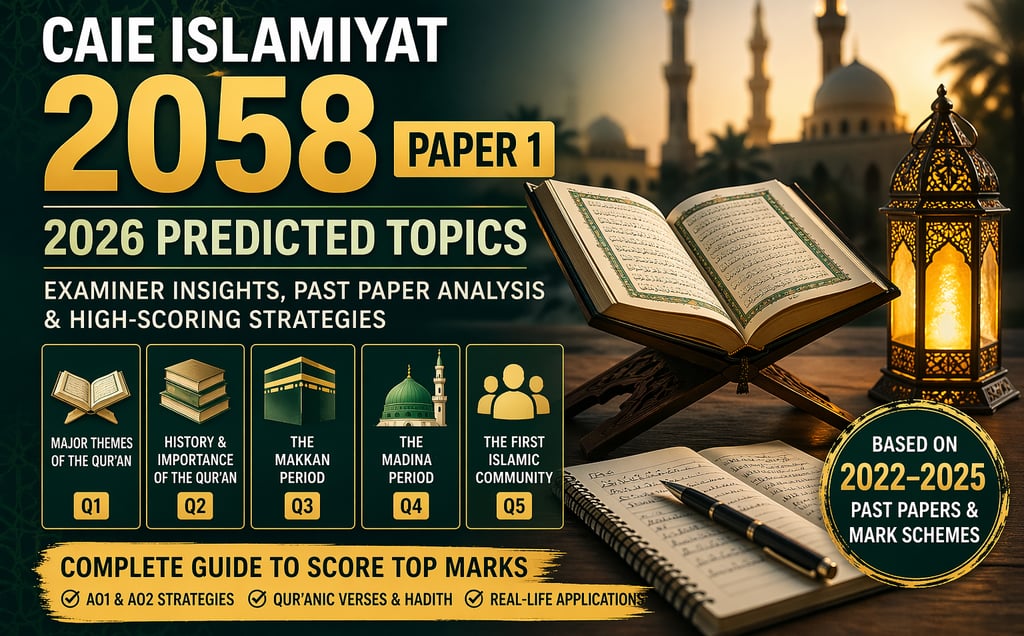
Success in CAIE Islamiyat 2058 Paper 1 is not about memorizing random facts, it’s about understanding how examiners award marks. Based on a detailed analysis of 2022–2025 papers and mark schemes, this guide highlights predicted topics, examiner expectations, and proven answering techniques to help you secure top grades.
4/21/20263 min read
What Examiners Stress Most (Key Assessment Insights)
Based on experience and careful detailed past paper review I have noticed that examiners consistently look for the following to award high marks:
Positive Awarding: Examiners are instructed to award marks for what a candidate knows and can do rather than deducting for omissions.
AO1 Structure and Quotes: For the 10-mark "Knowledge" part (a) questions, a Level 4 (8–10 marks) response must be well-structured, clear, and comprehensive. Most importantly, it is "likely to quote Qur’an verses and Hadiths to support points made".
AO2 Engagement and Reasoning: For the 4-mark "Understanding" part (b) questions, candidates must avoid simply repeating facts. A high-level response requires own opinions to engage with the question and present reasoning that demonstrates understanding.
Historical Accuracy: Detailed accounts including names (e.g., Waraqa ibn Nawfal), numbers (e.g., 30,000 men at Tabuk), and specific locations (e.g., Cave Thawr) are necessary for higher level AO1 marks.
Practical Application: In AO2 questions, examiners often ask for specific examples from everyday life (e.g., how the Prophet’s trustworthiness can be followed today).
Predicted Topics for O Level Islamiat Exam'26
Question 1: Major Themes of the Qur’an
Sura 93 (Ad-Duha): This passage appeared in the 2025 marking cycle and is frequently used to test the theme of God’s help to His Messengers.
Sura 6:75–79 (Abraham’s search for God): This is a key passage for the theme of Tawhid through signs in creation; it has not appeared as frequently in recent sessions compared to Sura 114.
Sura 1 (Al-Fatiha): Crucial for the theme of God’s relationship with the created world and its importance in daily prayer.
Question 2: History and Importance of the Qur’an
The Experience of the First Revelation: While "ways of revelation" appeared recently, a detailed account of the Cave Hira incident and its aftermath (Waraqa ibn Nawfal) is a staple and often returns.
Secondary Sources of Law (Ijma‘ and Qiyas): There is an increasing stress on how these sources solve modern-day problems (e.g., IVF, internet use, or drugs).
Part (b) Inclusion: The benefits of having the Qur’an in written form vs. memorized form or its availability on the internet.
Question 3: The Makkan Period
Migration to Abyssinia: This topic focuses on the first and second migrations, the role of King Negus, and the dialogue of Ja'far ibn Abi Talib.
Opposition and Persecution: Specifically the opposition from the Prophet’s family (Abu Lahab and his wife) and the support of Abu Talib.
Boycott of Banu Hashim: The three-year suffering in Shib-i-Abi Talib and its spiritual significance.
Question 4: The Madinan Period
The Battle of Badr: Focus on the events, the divine help (angels), and the treatment of prisoners of war.
The Constitution of Madina: The role it played in uniting Muslims (Ansar and Muhajirun) and the Jewish tribes.
Letters to the Kings/Emperors: A detailed account of envoys sent to rulers of Persia, Byzantium, and Abyssinia following Hudaybiyya.
Question 5: The First Islamic Community
Specific Mothers of the Believers: High emphasis is often placed on Khadija (as a role model for businesswomen) or Sawda and Hafsa.
Specific Blessed Companions: Focus on Salman al-Farsi (his quest for truth) or Hamza (Chief of Martyrs).
The Prophet’s Daughters: Specifically the life of Fatima and her relationship with her father.
Prediction Summary
Q1 (Passages) | Sura 93, Sura 6:75–79, Sura 1 | Allah’s power, guidance, human dependence
Q2 (Qur’an) | First Revelation, Ijma, Qiyas | Application to modern issues (technology, society)
Q3 (Makka) | Abyssinia Migration, Boycott | Patience, faith, non-violence under persecution
Q4 (Madina) | Badr, Constitution, Letters | Leadership, strategy, unity, diplomacy
Q5 (Community) | Khadija, Salman al-Farsi, Fatima | Role models, sacrifice, search for truth
Recommendation: Focus on memorizing at least one specific Qur’anic verse or Hadith for each topic above to secure the Level 4 bracket in part (a). For part (b), always prepare a "modern-day lesson" or "practical example" for every historical event.
AcademiaUK - Online Classes
Customized classes for IGCSE and A-Level subjects.
Contact
info@academiauk.com
© 2025. All rights reserved.